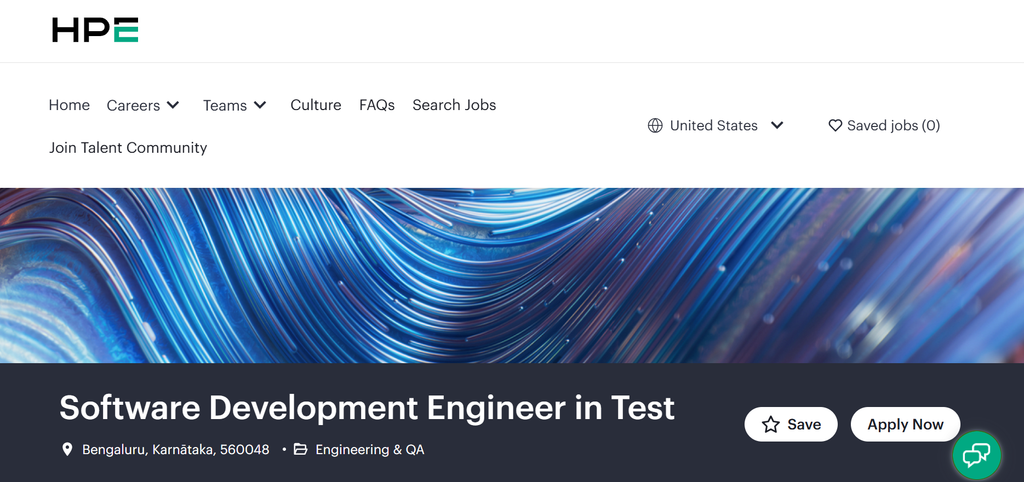
If you are an SDET or Software Quality Engineer with Python automation, Linux, storage systems and troubleshooting experience, Hewlett Packard Enterprise (HPE) is hiring for a Software Development Engineer in Test role in Bengaluru. This opportunity is especially relevant for professionals interested in HPC storage, filesystems, Kubernetes, containers, RAID and automated system testing.
🏢 About Hewlett Packard Enterprise
Hewlett Packard Enterprise is an edge-to-cloud technology company focused on helping organizations manage and transform their IT environments. HPE’s portfolio spans areas such as cloud, networking, compute, storage and high-performance computing, making it a significant environment for engineers interested in infrastructure and enterprise technology.
For QA professionals, HPE offers opportunities to work on complex products where testing involves more than UI validation. Storage-system testing can require understanding operating systems, filesystems, data movement, hardware/software interactions and distributed environments.
💼 Job Overview
- Company: Hewlett Packard Enterprise
- Role: Software Development Engineer in Test
- Experience: 4–6 Years
- Location: Bengaluru, Karnataka
- Work Mode: Hybrid
- Office Requirement: Average 2 days per week from an HPE office
- Primary Focus: Storage System QA & Test Automation
- Automation: Python / Perl / pytest
- Operating System: Linux
- Infrastructure: Kubernetes, Docker/Containers
- Domain: Storage / HPC / Filesystems
- Additional Technologies: RAID, Tiered Storage, CI/CD, Data Management
⭐ Why This Role Is Good for Experienced SDETs
This position is particularly relevant for QA engineers looking to move toward system-level and infrastructure testing rather than focusing exclusively on web applications.
The storage focus adds another layer of technical depth. Experience with Lustre or GPFS, HPC storage, RAID, tiered storage and data-management technologies can help professionals develop expertise in infrastructure products that require rigorous reliability and performance validation.
The position also provides exposure to Linux, containers, Kubernetes and CI/CD, making it relevant for SDETs interested in expanding into DevOps-oriented quality engineering.
🛠️ Skills Required
- Software Quality Engineering
- Python / Perl / Scripting
- pytest or comparable automation framework
- Test Automation Framework Development
- Functional & System Testing
- End-to-End Testing
- Regression Testing
- Linux
- Storage System Testing
- Filesystem Concepts
- Lustre / GPFS — advantage
- HPC Storage — advantage
- RAID
- Tiered Storage
- Data Movement & Data Management
- Kubernetes
- Docker / Containers
- CI/CD Pipelines
- Black-box Testing
- Test Planning & Test Case Design
- Defect Documentation
- Root Cause Analysis
- Troubleshooting
- Git/version control
🎯 Preparation Tips
1. Strengthen Linux: Prepare commands involving files, permissions, processes, networking, disks and system logs. Be ready to troubleshoot a failed automated test from the Linux command line.
2. Learn storage fundamentals: Revise RAID levels, filesystem concepts, storage tiers, capacity vs performance, I/O operations and data integrity. You don’t need to memorise definitions alone—understand how you would test them.
3. Understand parallel filesystems: Research the fundamentals of Lustre and GPFS and understand why parallel filesystems are used in HPC environments.
4. Build a pytest example: Be prepared to explain fixture usage, parametrisation, markers, assertions, test organisation and reporting. You should also be able to describe how you would design a maintainable automation framework.
5. Prepare storage-test scenarios: Think about how you would test a storage system during disk failure, node failure, data movement, capacity exhaustion, recovery and repeated read/write operations.
6. Revise containers and Kubernetes: Understand pods, deployments, containers, logs, networking and basic troubleshooting. The interviewer may explore how your automation interacts with containerised environments.
7. Prepare regression strategy: The JD specifically asks candidates to identify regression coverage for code changes. Prepare an example showing how you determine which tests should run after a particular change.
🧑💻 Expected HPE Interview Rounds
- Round 1 – Recruiter Screening: Experience, location, notice period, compensation and role alignment.
- Round 2 – Technical SDET Round: Python, automation frameworks, test design, debugging, Linux and QA fundamentals.
- Round 3 – Storage/System Testing Round: Filesystems, RAID, storage architecture, HPC, data movement and system-level testing.
- Round 4 – Managerial/Technical Discussion: Automation strategy, ownership, collaboration with developers, troubleshooting and project experience.
- Final HR/Offer Discussion: Compensation, joining timeline and employment formalities.
💰 Expected Salary Range
For a 4–6 year SDET with strong Python automation and storage/infrastructure expertise in Bengaluru, a practical market discussion range could be approximately ₹14–24 LPA. This is an indicative market estimate, not an official HPE compensation range; actual compensation can depend on level, technical expertise, existing compensation and the hiring team’s offer structure.
📄 Resume Tips for This HPE Role
- Start your summary with SDET / Software Quality Engineering + Python Automation.
- Highlight 4–6 years of relevant experience clearly.
- Put Linux and system-level testing near the top of your technical skills.
- Mention pytest or your strongest automation framework with measurable results.
- Showcase experience creating or maintaining automation frameworks, not simply executing scripts.
- If you have storage experience, explicitly mention RAID, filesystems, HPC, tiered storage or data movement.
- Add Kubernetes and Docker/containers if genuinely hands-on.
- Mention CI/CD pipeline integration.
- Quantify automation coverage, execution time reduction, regression reduction and defects detected.
- Include examples of troubleshooting complex system-level failures.
📩 How to Apply
👉 Application Link: Click Here
🤝 Referral Tip
Want to improve your chances of getting noticed?
Connect with someone at Hewlett Packard Enterprise and request a referral—it can significantly enhance your visibility in the hiring process.
Interested candidates can apply through the official HPE careers portal and search for the Software Development Engineer in Test position in Bengaluru. The role is listed as Hybrid, with an expectation of working from an HPE office an average of two days per week.
🔎 Role: Software Development Engineer in Test
📍 Location: Bengaluru
💼 Experience: 4–6 Years
🏢 Work Mode: Hybrid
🧪 Core Skills: Python | pytest | Linux | Storage | Kubernetes | Docker
⚙️ Domain: HPC Storage / Filesystems / Data Management
🚀 Final Thoughts
This HPE SDET opportunity brings together automation engineering, Linux, storage systems and modern infrastructure technologies. Candidates should prepare beyond conventional Selenium/API testing and demonstrate their ability to design automation, troubleshoot Linux-based systems, understand storage behaviour and build meaningful regression coverage. A resume that clearly connects automation expertise with infrastructure or storage testing will be closely aligned with the technical focus of this position.