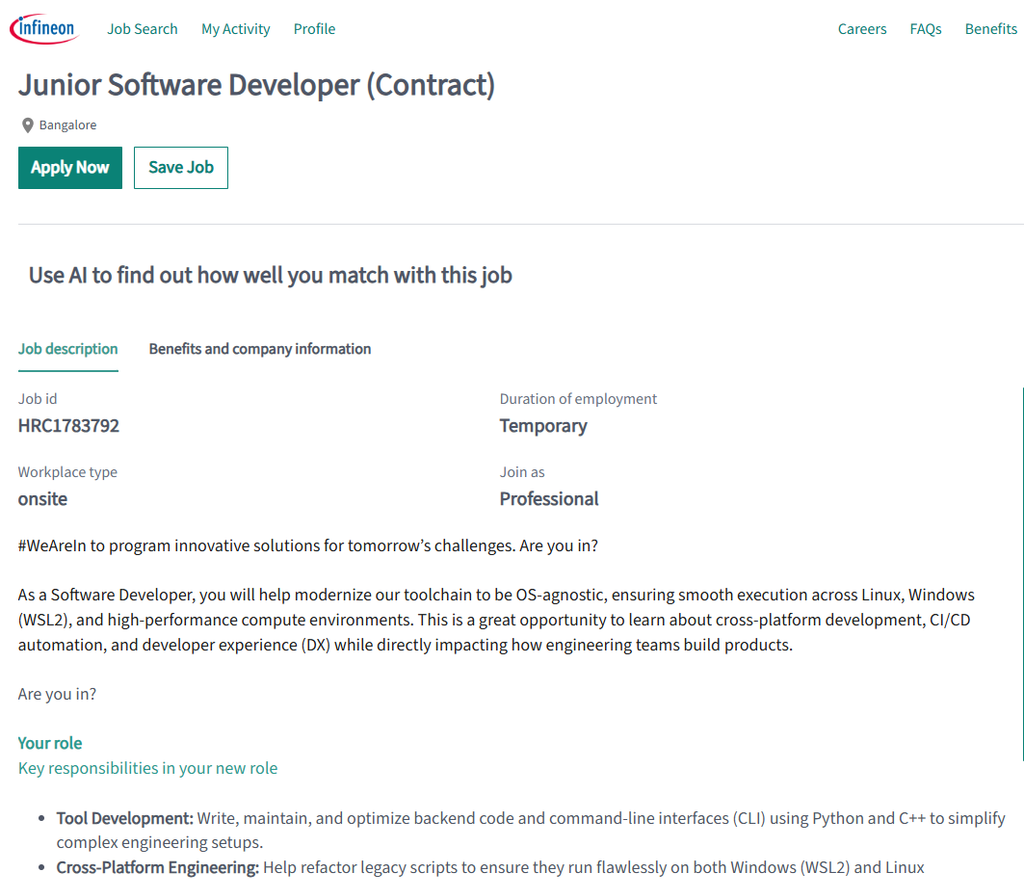
Infineon Technologies is hiring a Junior Software Developer (Contract) for its Bangalore location. This opportunity is particularly relevant for recent graduates and software developers with 0–2 years of experience who want to work at the intersection of software development, developer tools, automation, and semiconductor engineering workflows.
📌 Job Details
• 💼 Position: Junior Software Developer (Contract)
• 🏢 Company: Infineon Technologies
• 📍 Location: Bangalore
• 🧑💻 Experience: 0–2 Years
• 🎓 Education: Bachelor’s/master’s in computer science, Computer Engineering, Electrical Engineering or related field
• 📝 Employment: Temporary / Contract
• 🏢 Workplace: Onsite
• 🆔 Job ID: HRC1783792
• 🐍 Primary Programming: Python and/or C++
• 🖥️ Environments: Linux, Windows, WSL2
• 🔧 Tools: Git, Jenkins, Bash, YAML, JSON, CI/CD
🏢 About Infineon Technologies
Infineon Technologies is a global semiconductor company developing technologies used across automotive, power systems, IoT, communications, security and other technology applications. Its engineering environment combines hardware and software development, making this role different from a conventional junior software position.
For this opening, the focus is on modernizing engineering toolchains so that internal tools can operate consistently across Linux, Windows through WSL2, and high-performance computing environments. The role therefore provides exposure to software engineering practices that support complex hardware and simulation workflows.
💡 Why This Role Is Good for Experience?
A junior developer can build practical experience in areas such as:
• 🐍 Developing backend and command-line tools with Python/C++
• 🐧 Working with Linux command-line environments and Windows WSL2
• 🔄 Understanding how CI/CD pipelines validate software automatically
• 🧪 Writing unit tests, validation scripts and automated stress-test support
• 📦 Working with JSON, YAML and XML for tool-to-tool data exchange
• 🛠️ Refactoring legacy scripts and removing operating-system-specific dependencies
• 💬 Designing useful error messages and troubleshooting hints
🎯 Skills Required
You should also understand:
• 🐧 Linux commands, shell navigation, permissions, processes and environment variables
• 🪟 Windows command-line basics and WSL2 concepts
• 🔀 Git fundamentals including clone, branch, commit, merge, pull and resolving conflicts
• 🔧 Bash scripting and basic build automation
• 🔄 CI/CD concepts such as automated builds, validation and test execution
• 📄 JSON/YAML/XML syntax and serialization concepts
• 🧪 Unit testing and automated validation
• 🖥️ CLI design and argument handling
• 🔬 Basic EDA, SystemC or hardware simulation concepts can provide an additional advantage
📝 Preparation Tips
Start with Python or C++ programming problems, but don’t prepare only traditional DSA questions. Practice building a small CLI utility—for example, a Python command-line tool that reads a YAML/JSON configuration file and performs an automated task.
Next, revise Linux and Windows command-line concepts. Be prepared to explain the difference between Linux and Windows environments and why WSL2 can be useful for cross-platform development.
Practice Bash scripting and environment variables because the role involves replacing hardcoded OS dependencies with dynamic configuration. Understand how a script can detect or consume paths, variables and environment-specific settings.
For CI/CD preparation, learn how a Jenkins pipeline can automatically run linters, unit tests and validation scripts after code changes. You should be able to explain the purpose of CI/CD even if you have limited professional experience.
Also practice debugging. The JD specifically mentions exceptions, human-readable error messages and “fix hints,” so interviewers may evaluate how you approach a failing tool or confusing error.
🧑💼 Expected Interview Rounds at Infineon
• Round 1 – Technical Screening: Programming fundamentals, Python/C++, data structures, debugging and basic problem-solving.
• Round 2 – Technical Interview: Linux/Windows CLI, Git, Bash, JSON/YAML, CI/CD, testing and scripting. Questions may connect directly to the toolchain responsibilities described in the JD.
• Round 3 – Role/Project Discussion: Cross-platform development, WSL2, developer experience, automation and potentially EDA/SystemC or simulation workflows.
• Round 4 – Manager/HR Discussion: Communication, learning mindset, availability, contract conditions, location and overall role alignment.
💰 Salary Range
The official job description does not specify a salary range for this temporary position. Compensation can vary based on experience, educational background, contract terms and Infineon’s internal compensation structure. Candidates should therefore verify the exact compensation and contract benefits during the recruitment process rather than relying on generic online estimates.
📄 Resume Tips for This Job
Keep your resume strongly aligned with the toolchain nature of this position. Put Python/C++, Linux, Git, Bash, Jenkins/CI/CD, WSL2, JSON/YAML and testing prominently in your technical skills.
If you have created a CLI application, automation script, build tool, test framework or developer utility, give it priority under projects. Describe the technical outcome—for example, how your script automated validation, processed configuration files or reduced manual steps.
For projects involving embedded systems, hardware simulation, SystemC, EDA or electronics, mention them clearly because they connect directly with the role.
📌 How to Apply
👉 Application Link: Click Here
Candidates interested in the Junior Software Developer (Contract) opportunity in Bangalore should apply through the official Infineon recruitment process using Job ID HRC1783792. Make sure your resume accurately reflects your programming, scripting, Linux/Windows, Git, CI/CD and testing experience before submitting the application.
🚀 If you are a fresher or early-career developer looking to build experience in software tooling, automation and cross-platform engineering, this Infineon opportunity offers exposure to a technically diverse environment where software directly supports engineering workflows.