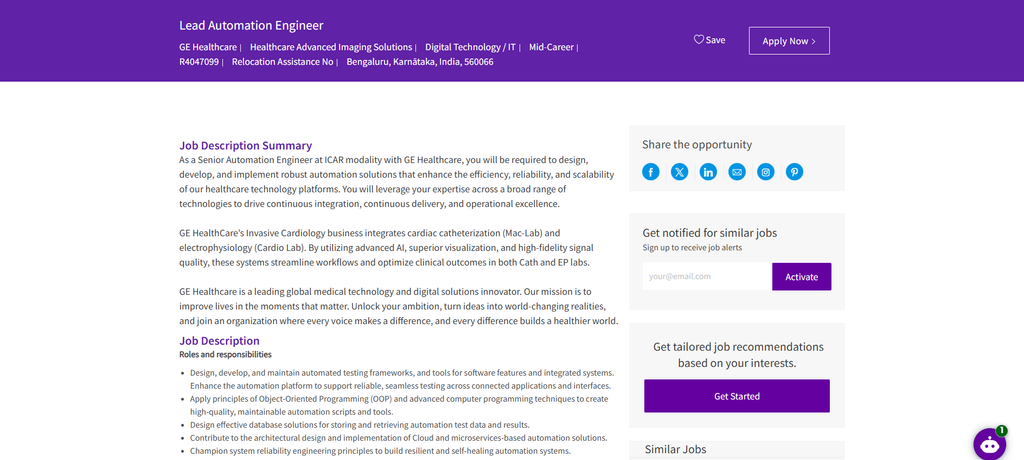
GE HealthCare is hiring an experienced Lead Automation Engineer / Senior Automation Engineer for its Healthcare Advanced Imaging Solutions business in Bengaluru, Karnataka. This opportunity is suited to automation professionals with strong programming expertise, automation framework development experience, and an interest in testing complex, integrated healthcare technology systems. The position focuses on automation platform enhancement, software verification, system reliability, cloud and microservices-based solutions, and continuous improvement. Candidates with 8+ years of experience, particularly in C++, C#, BDD, requirements-based testing, and regulated product environments, should review this opportunity carefully.
📌 Job Overview
- Company: GE HealthCare
- Job Title: Lead Automation Engineer
- Role Description: Senior Automation Engineer
- Job ID: R4047099
- Business Area: Healthcare Advanced Imaging Solutions
- Location: Bengaluru, Karnataka, India – 560066
- Experience: 8+ years
- Job Category: Digital Technology / IT
- Career Level: Mid-Career
- Primary Skills: C++, automation frameworks, OOP, BDD, integrated systems testing, test data management, reliability engineering
- Additional Skills: C#, Jama, ALM/Quality Center, cloud, microservices, cybersecurity awareness, AI-assisted development
- Application: Search for job ID R4047099 on GE HealthCare’s official careers portal.
🏢 About GE HealthCare
GE HealthCare is a global medical technology and digital solutions company focused on improving patient care through healthcare technologies. Its products and solutions support clinicians and healthcare organizations across imaging, diagnostics, monitoring, and other clinical applications. This position supports the company’s invasive cardiology business, which integrates Mac-Lab cardiac catheterization systems and Cardio Lab electrophysiology systems. These technologies support clinical workflows in catheterization and electrophysiology laboratories, where reliable software behavior and high-quality signals are important.
💼 Key Responsibilities
- Enhance the automation platform to support reliable testing across connected applications and interfaces.
- Contribute to cloud-based and microservices-oriented automation architecture.
- Apply system reliability engineering principles to create resilient and self-healing automation systems.
- Develop regression, performance, stress, recovery, and reliability tests where required.
- Investigate intermittent failures, perform root-cause analysis, and drive corrective improvements.
- Maintain traceability between requirements, test cases, execution results, and defects.
- Collaborate with software, systems, quality, product, and release teams to deliver dependable releases.
⭐ Why Is This Role Good for Experienced Professionals?
This opportunity is well suited to experienced SDETs and automation engineers who want to move from test-script execution toward framework architecture, integrated-system verification, and reliability engineering. It combines programming, platform enhancement, test data design, and cross-functional engineering collaboration. Professionals with medical-device or other regulated-product experience can apply their knowledge of risk-based testing, requirements traceability, and documented evidence. Engineers from other industries can also demonstrate transferable expertise in complex systems, recovery testing, automation infrastructure, and root-cause analysis.
🧠 Skills Required
- C++ programming: Object-oriented design, reusable components, debugging, memory concepts, and maintainable automation code.
- C#/.NET: A valuable additional skill for developing automation utilities and working with compatible testing ecosystems.
- Automation framework architecture: Modular design, reusable libraries, test execution management, logging, reporting, and framework scalability.
- BDD and test design: Translating requirements into scenarios, defining acceptance criteria, and maintaining clear, repeatable automated checks.
- Integrated systems testing: Validating interfaces, data exchange, dependencies, and end-to-end behaviour across connected components.
- Database and test data management: Structuring, storing, retrieving, and validating test data and execution results.
- Reliability engineering: Regression, stress, recovery, failure analysis, and resilience testing.
🎯 Preparation Tips
- Prepare a C++ automation framework walkthrough: Explain its architecture, object model, reusable components, error handling, logging, and reporting. Be ready to justify your design decisions.
- Practise requirements traceability: Demonstrate how you map a product requirement to risk assessment, test cases, execution results, defects, and final verification evidence.
- Study integrated-system scenarios: Explain how you would test communication between connected applications, validate data consistency, and isolate failures across system boundaries.
- Revise cloud and microservices testing: Understand service dependencies, API contracts, timeouts, retries, observability, and how to test partial failures.
- Understand regulated-product quality: Review risk-based verification, change impact analysis, reproducible evidence, and why test documentation matters in medical technology.
🗣️ Expected Interview Rounds
- Recruiter screening: Experience, location, availability, compensation expectations, and role alignment.
- Technical programming round: C++, OOP, coding, debugging, framework design, and potentially C#.
- Automation and system testing round: Framework architecture, integrated testing, reliability scenarios, databases, and test strategy.
- Quality and engineering discussion: Requirements traceability, risk-based verification, regulated-product practices, and cross-team collaboration.
- Hiring manager/HR discussion: Ownership, prioritisation, stakeholder communication, and compensation. The actual process may differ.
💰 Expected Salary Range
The job description does not publish a salary band. For planning purposes only, an unofficial estimate of ₹18–32 LPA may be a reasonable broad range to investigate for an experienced automation engineer with 8+ years in Bengaluru. This is not confirmed GE HealthCare compensation; the offer can vary significantly with technical depth, relevant healthcare experience, internal level, and current salary.
📄 Resume Tips
- Lead with Automation Engineering | C++ | Framework Development | Integrated Systems Testing if these match your experience.
- Showcase measurable improvements in test coverage, execution time, framework reliability, or defect detection.
- Highlight framework architecture and technical ownership, not just the number of automated test cases.
- Include Jama, ALM/Quality Center, traceability, and verification evidence if you have used them.
- Describe reliability, recovery, performance, and root-cause analysis projects with concrete outcomes.
- Mention medical-device or regulated-product testing prominently if applicable; never claim regulated experience you do not have.
📩 How to Apply
👉 Application Link: Click Here
Visit GE HealthCare’s official careers portal and search for Job ID R4047099 – Lead Automation Engineer, Bengaluru. Review the official eligibility details and submit an updated resume emphasizing C++, automation framework design, system reliability, and requirements-based verification. Confirm the exact title and employment terms on the listing before applying, as the announcement uses “Senior Quality Assurance Engineer” while the detailed requisition identifies the role as “Lead Automation Engineer.”