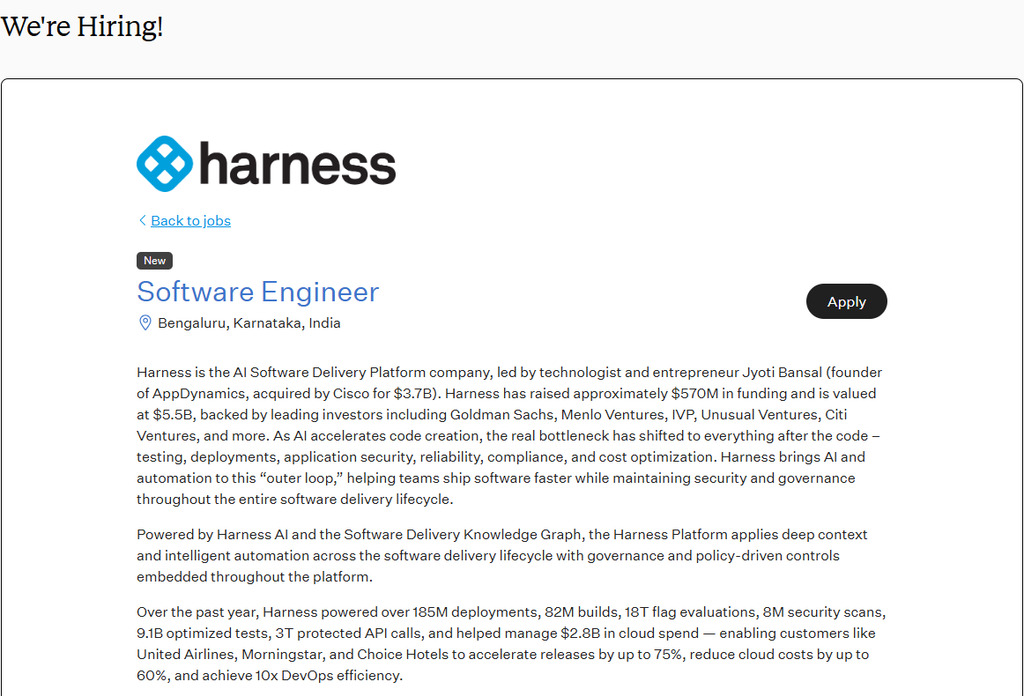
Harness is hiring a Software Engineer for its Bangalore engineering team. This opportunity is aimed at software engineers with 2–3 years of experience building scalable and distributed applications using Golang, Java, or similar programming languages. The role involves distributed systems, cloud technologies, Kubernetes, Docker, MongoDB, Redis, algorithms, debugging, and production troubleshooting.
The position follows a hybrid work model in Bangalore and is particularly relevant for engineers interested in building developer-focused products in a fast-moving software company.
📌 Job Details
🏢 Company: Harness
💼 Role: Software Engineer
📍 Location: Bangalore, Karnataka
🏠 Work Mode: Hybrid
🧑💻 Experience: 2–3 Years
💻 Languages: Golang, Java or similar
☁️ Cloud: GCP / AWS / Azure
🐳 Technologies: Docker, Kubernetes, MongoDB, Redis
🧠 Core Concepts: Data Structures, Algorithms, Distributed Systems, Software Design
🔄 Methodology: Agile / Iterative Development
🎓 Qualification: B.Tech in Computer Science or equivalent
🤖 AI Tools: Cursor, GitHub Copilot, Claude
🏢 About Harness
Harness describes itself as an AI Software Delivery Platform company focused on helping organizations manage software delivery activities such as testing, deployments, application security, reliability, compliance, and cloud cost optimization.
Harness was founded by technologist and entrepreneur Jyoti Bansal, who also founded AppDynamics. The company says its platform combines Harness AI and a Software Delivery Knowledge Graph to provide context and automation throughout the software delivery lifecycle.
🌟 Why Is This Role Good for Your Experience?
This opportunity is designed around real software engineering rather than isolated feature development. Engineers are expected to design scalable algorithms, understand distributed systems, take ownership of complex components, and diagnose production issues.
Working with Golang/Java, Kubernetes, Docker, MongoDB and Redis can provide valuable exposure to modern backend and cloud-native engineering. The role also involves collaboration with Site Reliability Engineers, giving engineers opportunities to understand production reliability and performance.
🛠️ Skills Required
✅ Golang or Java
✅ Data Structures and Algorithms
✅ Object-oriented and software design principles
✅ Distributed systems fundamentals
✅ Scalable and resilient application development
✅ Docker and containerization
✅ Kubernetes fundamentals
✅ MongoDB
✅ Redis and caching concepts
✅ GCP/AWS/Azure fundamentals
✅ Debugging and troubleshooting
✅ Production issue analysis
✅ REST/API and backend development concepts
✅ Git and collaborative development
✅ Agile development practices
✅ System design fundamentals
✅ AI-assisted development tools such as Cursor, Copilot or Claude
🎯 Preparation Tips for This Harness Role
1. Pick one primary language: Be extremely comfortable in either Golang or Java. Revise language fundamentals, concurrency, error handling, interfaces/classes, collections/data structures and writing production-quality code.
2. Practise DSA: Prepare arrays, strings, hash maps, stacks, queues, trees, graphs, sorting, searching, recursion and complexity analysis. Focus on explaining your approach rather than only producing the final code.
3. Study distributed systems: Understand horizontal scaling, load balancing, service-to-service communication, retries, timeouts, fault tolerance, replication, consistency, caching and graceful failure.
4. Learn Kubernetes practically: Know pods, deployments, services, config maps, secrets, scaling and basic troubleshooting. Understand how a backend service moves from code to a containerized deployment.
5. Revise Docker: Be able to explain Dockerfiles, images, containers, networking and environment configuration. Prepare an example of containerizing a simple Java or Go service.
6. Understand MongoDB and Redis: Revise document-oriented data modelling, indexes and common MongoDB operations. For Redis, understand caching, TTLs and scenarios where caching can improve application performance.
7. Prepare production-debugging scenarios: The JD specifically mentions diagnosing distributed-computing problems and production performance issues. Practise explaining how you would investigate logs, metrics, latency, error rates, resource usage and service dependencies.
🧑💼 Expected Harness Interview Rounds
🔹 Recruiter/Initial Screening: Background, experience, location, notice period and interest in Harness.
🔹 Coding/Technical Round: Data structures, algorithms, programming fundamentals and debugging.
🔹 Backend/Systems Round: Distributed systems, scalable application design, cloud technologies and production scenarios.
🔹 Hiring Manager/Team Round: Project ownership, engineering decisions, collaboration, code reviews and working in an iterative startup environment.
🔹 Final/HR Discussion: Compensation, benefits, hybrid working arrangements and employment details.
💰 Salary Range
The supplied job description does not disclose a fixed salary range for this Bangalore position. Public compensation data for Harness can vary substantially by role, level, experience and equity structure, so candidates should not treat generic online estimates as the official package for this vacancy.
For a 2–3 year software engineer, compensation can vary based on Golang/Java expertise, distributed-systems experience, cloud knowledge, interview performance, and the company’s level/offer structure. Candidates should confirm the exact base salary, variable compensation and equity/stock components during the recruitment process.
📄 Resume Tip
Your resume should immediately highlight Golang/Java + Distributed Systems + DSA + Cloud. Avoid making the resume look like a generic frontend or CRUD-backend profile.
Use project bullets that demonstrate scalability, concurrency, APIs, caching, databases, containerization or production troubleshooting. If you have worked with Kubernetes, Docker, MongoDB, Redis or GCP/AWS/Azure, connect each technology to an actual project.
Quantify results where accurate—for example, improved API latency, increased throughput, reduced resource usage, or supported a particular workload.
🚀 How to Apply
👉 Application Link: Click Here
Candidates interested in the Software Engineer position should apply through Harness’s official careers application process using the job listing provided by the company.
Before applying, ensure your resume clearly demonstrates 2–3 years of software development experience, strong programming fundamentals, distributed-systems understanding, and relevant exposure to cloud-native technologies.
🔎 Final Takeaway
The Harness Software Engineer opening combines backend development, distributed systems, cloud-native technologies and production engineering. Candidates should focus their preparation on Golang/Java, DSA, system design, Kubernetes, Docker, MongoDB, Redis, cloud fundamentals and real-world debugging. The additional requirement for familiarity with AI-assisted development tools makes practical knowledge of modern AI-enabled engineering workflows relevant to this opportunity.